

This article was contributed by reader Praveen Katiyar.
Most of us pay for insurance—vehicle, health, life, and more—every year. Since insurance is a recurring, unavoidable expense, it makes sense to choose a payment method that earns the most reward points (RPs) and preserves the credit card’s free-credit period.

Many credit cards either don’t award RPs on insurance payments or apply caps. This article summarizes practical strategies to maximize reward earnings on insurance premiums. Feel free to share your own experiences.
Note: From 1st Dec 2019, LIC removed upper payment limits on single transactions and stopped charging convenience fees for credit card payments, as shown below.
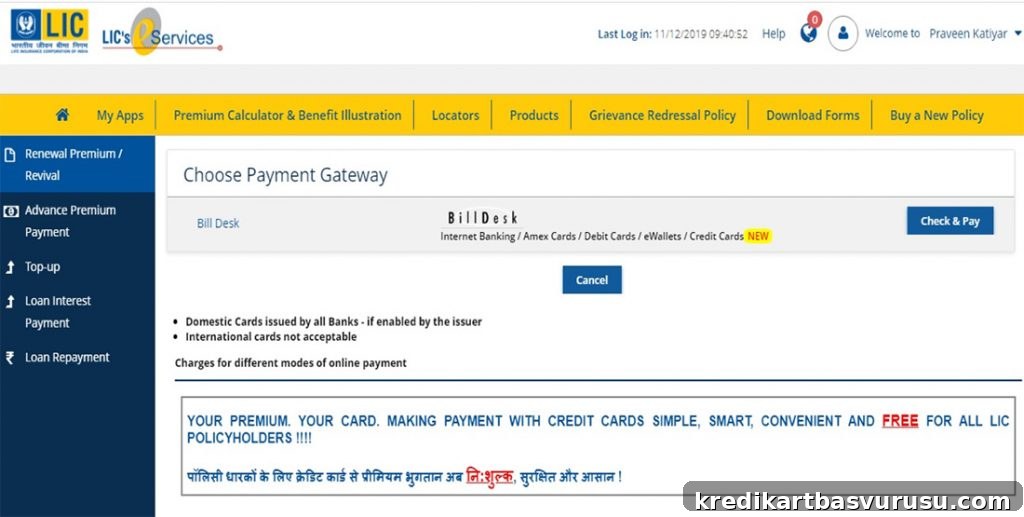
In my experience, other insurers (for example, Bajaj Allianz, Axa, or Sriram General Insurance) also often allow credit card payments without a convenience fee. With fees removed or reduced, the question becomes: which cards give the best returns on insurance premiums?
Below I categorize recommendations by issuing bank and highlight key cards and their effective reward rates.
Table of Contents
- HDFC Bank
- SBI Cards
- Axis Bank
- ICICI Bank
- Standard Chartered
- Yes Bank Credit Cards
- American Express
- Bottomline
HDFC Bank
- Diners Black / Infinia: Caps apply — up to 2,000 RPs per transaction and 5,000 RPs per day on insurance payments.
- Other HDFC cards: Generally capped at 2,000 RPs per day for insurance payments.
HDFC occasionally runs promotional multipliers (for example, 2X or 5X reward campaigns) on insurance spends, so watch for such offers.
SBI Cards
- ELITE: 2 RPs per ₹100 spent (roughly 0.5% value).
- Prime: 2 RPs per ₹100 spent (0.5% value). Standing instructions can earn 20 RPs per ₹100 on recurring payments, capped at 3,000 points per month.
- IRCTC Card: 1 RP per ₹125 spent (≈0.8% value).
ELITE and Prime cards also help toward milestone rewards, which can increase effective returns when milestones are reached.
Axis Bank
- Vistara Credit Cards: Rewards vary by variant; premium variants can translate to very high value when converted to airline benefits (examples include high percentage returns for top-tier cards).
- Axis Privilege: Around 2% value returned as travel vouchers.
- Axis Flipkart Card: Approximately 1.5% cashback with no capping.
For many regular and premium cardholders, Axis cards offer strong returns on insurance spends, especially when combined with milestone rewards and category benefits.
ICICI Bank
- Emeralde / Coral / Rubyx / Sapphiro: 1 Payback point per ₹100 spent (about 0.25% value).
- Amazon Pay Credit Card: 1% back as Amazon Pay balance (1% value).
Although the Amazon Pay card offers a straightforward 1% back, premium ICICI cards with waived annual fees on high spends (for example, fee waived at ₹15 lakh annual spend) can be attractive if you have large insurance payments or overall high spend.
Standard Chartered
- Ultimate: 5 reward points per ₹150 spent — an effective value that can be attractive compared with many competitors (roughly 3.3% in value when converted depending on redemption).
Yes Bank Credit Cards
Yes Bank awards reward points on insurance payments according to each card’s earn rate:
- Yes First Exclusive: 6 RPs per ₹100 spent (≈1.5% value).
- Yes First Preferred: 4 RPs per ₹100 spent (≈1% value).
Both cards include milestone rewards that can raise effective returns when milestones are met.
American Express
By default, Amex typically does not award RPs on direct insurance payments, though some premium cards offer milestone rewards or limited-time promotions (for example, 5X RPs on insurance with caps). Occasional targeted offers may also appear.
One common workaround is using Amex to load payment wallets or prepaid instruments that accept card loads and then pay insurance from the wallet. This can earn points on the Amex side, though check wallet terms and any loading fees before proceeding.
Bottomline
There are several good options to earn rewards on insurance payments, and the best choice depends on your card portfolio, reward redemptions you prefer (cashback, vouchers, airline points), and whether your cards offer milestone benefits. Reward rates and promotions change over time, so review current offers and consider milestone-earning cards if you want consistently higher effective returns.
Which card do you use to pay insurance premiums? Share your experience in the comments below.